
When people shop for an outdoor canopy, they usually look at size, color, and price first.
Is a 10×10 large enough?
Does the color look good?
Is it easy to fold?
Is the price worth it?
Those questions matter. But if you plan to use a canopy for markets, trade shows, sports events, food booths, backyard gatherings, or brand activations, there is one more question worth asking:
Can the material handle repeated outdoor use?
That is why vinyl outdoor materials are worth understanding.
Vinyl is commonly used in outdoor covers, protective surfaces, sidewalls, commercial displays, and weather-resistant products. Its value is not only that it feels thicker or stronger. Its real value is that it can support better protection, easier cleaning, and more reliable long-term performance in outdoor environments.
For ABCCANOPY, a canopy is not just a temporary shade product. It is part of an outdoor setup that can be used, displayed, stored, transported, and set up again. Understanding vinyl helps buyers make better decisions about which canopy, wall, and accessory combination fits their real use.
What Is Vinyl, and Why Does It Work Outdoors?
Vinyl is a synthetic material widely used in outdoor products, covering materials, advertising displays, flooring, wall surfaces, and protective fabrics.
It works well outdoors because it can offer practical advantages such as water resistance, abrasion resistance, easier cleaning, and improved surface protection against sun, dust, and daily handling.
For canopy tops and walls, the outdoor environment is not gentle.
Sunlight can fade materials.
Rain can test water resistance.
Wind can pull on corners and attachment points.
Dust, mud, grass, and food stains can affect appearance.
Repeated folding and transport can create friction over time.
Some materials may look fine at first, but after several uses, they may soften, wrinkle, fade, leak, or become hard to clean.
The purpose of vinyl-style outdoor material is to help a setup keep better structure and protection through repeated use.
Why Commercial Buyers Should Care About Material
A home user who sets up a canopy in the backyard once in a while may not notice material differences right away.
Commercial users notice them much faster.
Market vendors may set up every week.
Food booths may deal with steam, water, spills, and customer traffic.
Trade show teams need the booth to look professional every time.
Sports teams and schools need equipment that can be moved repeatedly.
Brand activation teams need the canopy to look clean and consistent in photos, videos, and live events.
If the material is not durable enough, problems appear quickly.
The top fades, and the booth looks less fresh.
The sidewalls wrinkle, and the setup feels temporary.
Rain gets through, and products or printed materials are affected.
The surface is hard to clean, so stains from one event follow you into the next.
Corners and attachment points loosen, and the setup no longer looks tight.
Commercial buyers are not only buying fabric.
They are buying a long-term presentation standard.
That is where ABCCANOPY becomes useful. It helps users move from “good enough for one day” to an outdoor setup that can perform repeatedly.
How Vinyl Thinking Improves Canopy Protection
A strong outdoor canopy needs to handle more than one type of weather.
Sun, rain, wind, dust, ground moisture, transport friction, and repeated handling all affect the life of the product.
Vinyl-style materials are often used in outdoor products where protection matters because they can improve surface durability and cleanability.
For canopy buyers, this material thinking points to several important benefits:
Better resistance to water exposure.
Easier wipe-down cleaning after events.
A stronger surface feel for tops and walls.
A cleaner display area for branding.
Better suitability for repeated use instead of one-time events.
Of course, the final performance depends on the full product design, including fabric structure, coating, thickness, stitching, attachment method, and how the product is used.
Material is the foundation.
The complete setup is what makes it perform.
That is why buyers should not only ask whether they need a canopy. They should also consider whether they need canopy tent sidewalls, weights, custom printing, and replacement parts to create a complete system.
Sidewalls Show the Value of Material Fast
If the canopy top provides overhead shelter, sidewalls are where material quality becomes easy to notice.
Sidewalls sit closer to people. They also come into contact with wind, rain, dust, tables, chairs, products, and customer traffic.
A good sidewall does more than block side sun.
It creates a boundary, protects products, adds privacy, reduces wind, displays brand information, and makes the entire booth feel more complete.
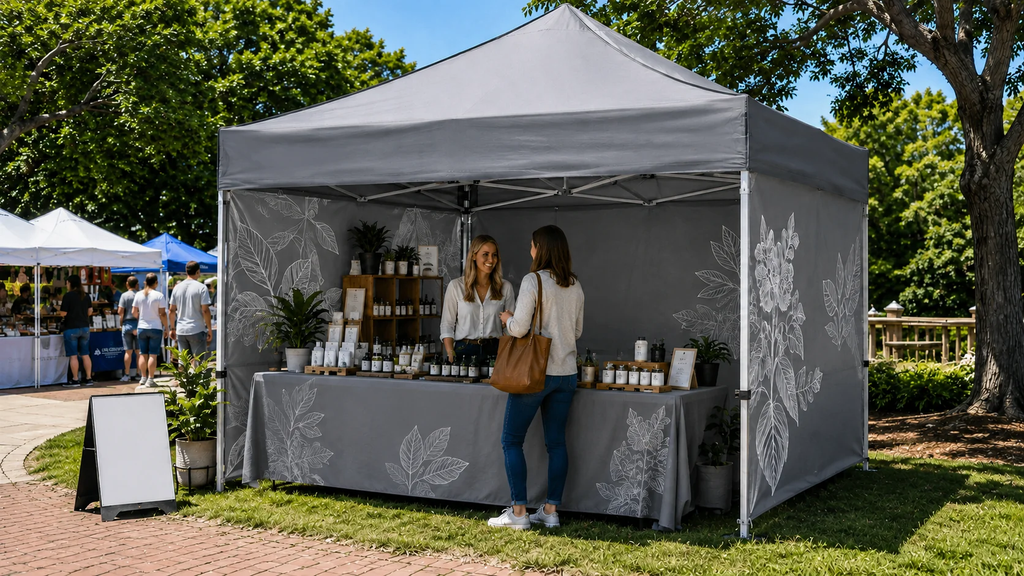
In a market booth, a sidewall can work as a backdrop.
In a food booth, it can help separate the service area from the customer area.
At a trade show, it can display logos, examples, and QR codes.
At a sports event, it can block low-angle sun and make the team area more comfortable.
If a sidewall material is too soft, too thin, too wrinkled, or hard to clean, the whole space can look less professional.
A stronger, easier-to-maintain wall material can turn the sidewall into more than an add-on. It becomes protection, structure, and display space.
For many users, upgrading to custom printed sidewalls is one of the easiest ways to make the canopy feel more like a real branded environment.
Why Custom Printing Depends on the Material
Many people think custom printing is only about design.
Is the logo attractive?
Are the colors bright?
Is the font easy to read?
But material matters too.
Printing does not float in the air. It lives on the fabric surface.
If the surface is not smooth, durable, or suitable for repeated outdoor use, the printed result may not keep a professional look over time.
For ABCCANOPY business users, custom canopies are often used at brand booths, product displays, food events, school activities, community programs, and outdoor promotions.
These events need more than a good first photo. They need the setup to look reliable every time it is used.
Good custom printing should do three things:
Make the brand visible from a distance.
Make the message easy to read up close.
Keep the booth looking clean, clear, and trustworthy after repeated use.
That is the relationship between material and printing.
The material carries the message.
The printing expresses the brand.
Together, they turn a canopy from a shade product into a brand asset.
For vendors and brands that need stronger visibility, a custom printed canopy tent can make the whole setup easier to recognize in crowded outdoor spaces.
Anchoring Protects the Material and the Event
Many people talk about material by looking only at the top and walls.
But anchoring matters too.
If a canopy is not properly secured, the material takes more stress.
Wind pulls the top.
Sidewalls act like sails.
Attachment points shake repeatedly.
Corners, zippers, hook-and-loop strips, and straps all take extra pressure.
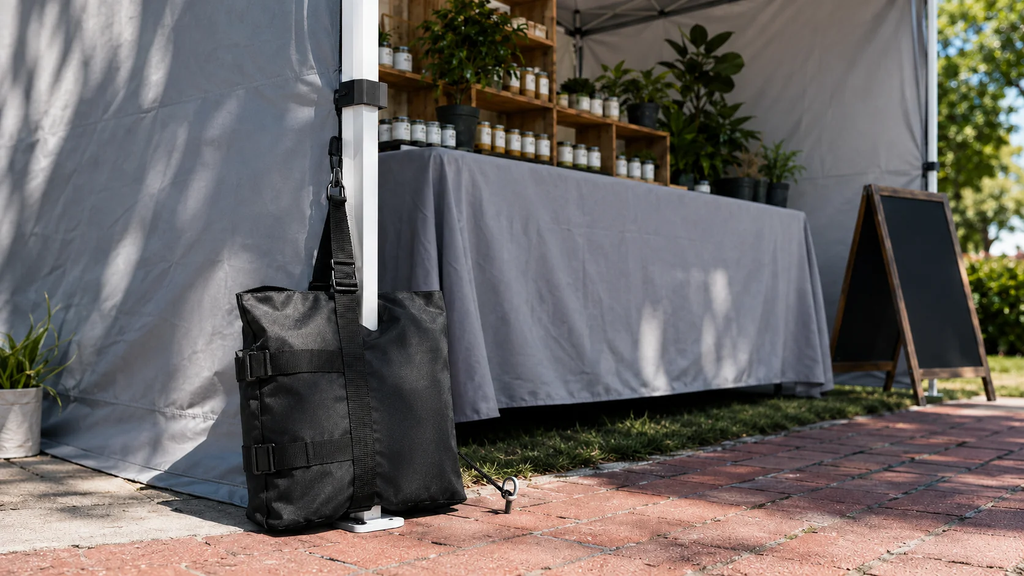
That means weight bags, stakes, and ropes are not just safety accessories. They also help reduce unnecessary stress on the fabric and attachment points.
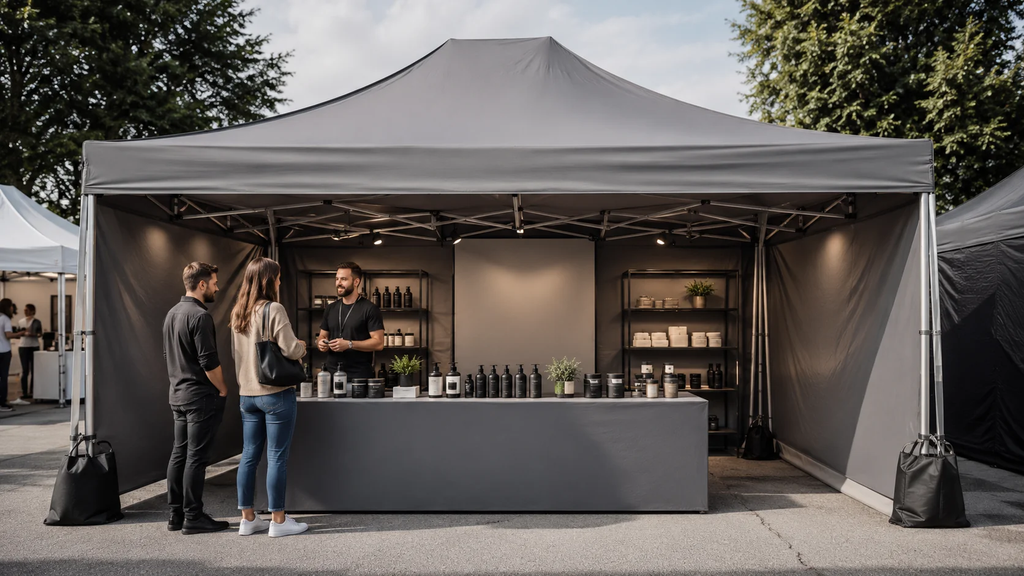
ABCCANOPY weight bags help stabilize all four legs, especially on hard surfaces, vendor spaces, trade shows, and locations where stakes cannot be used. Once sidewalls are added, anchoring becomes even more important because walls increase wind exposure.
A stable frame and a proper anchoring system help the entire setup feel safer and last longer.
For most outdoor setups, canopy weight bags should be treated as part of the core system, not an optional afterthought.
How to Choose the Right ABCCANOPY Outdoor Setup
If you mainly use a canopy for the backyard, poolside shade, or camping, choose a portable canopy with one or two sidewalls and basic weight bags. Focus on shade, airflow, easy storage, and comfort.
If you are a market vendor, consider a 10×10 canopy tent with a branded table cover, back wall, half wall, and weight bags. The goal is to be visible from far away, easy to understand up close, and comfortable enough for customers to stop.
If you run a food booth, pay extra attention to easy-clean surfaces, sidewalls, window walls, table covers, and a clear service path. The easier the material is to maintain, the easier cleanup becomes after the event.
If you are a brand or trade show team, choose a custom printed canopy, sidewalls, table cover, and flags so the whole space looks consistent. The goal is visibility, trust, and better photo-ready presentation.
If you already have a canopy frame but the top is faded or damaged, consider a replacement canopy top instead of buying a full new setup. This can lower cost while extending the life of the frame.
If you attend events often, prepare weight bags, storage bags, replacement walls, and spare accessories. The part that affects your event most is often the one you forgot to bring.
What Vinyl Education Teaches Buyers
Learning about vinyl is not about becoming a material expert.
It is about buying outdoor equipment with a better eye.
Do not look only at color. Ask whether the material can handle outdoor sun.
Do not look only at price. Ask whether the product can be used repeatedly.
Do not look only at size. Ask whether it is easy to clean and maintain.
Do not buy only the top. Think about sidewalls, weights, and storage.
Do not judge only the first setup. Think about how the canopy will look after the third, fifth, or tenth use.
For home users, this means more comfort and less trouble.
For commercial users, it means a cleaner brand image, lower long-term replacement cost, and better conversion opportunities at events.
ABCCANOPY’s outdoor setup value is not only shade.
It is preparation.